Seven staff members at the Sayram Lake Scenic Area have been put to 10 to 15 days of administrative detention and fined 1,000 yuan ($148) each for assaulting a tour bus driver, according to a report released on Monday by a joint task force formed by the Xinjiang Uygur Autonomous Region and the Bortala Mongolian Autonomous Prefecture, which is under jurisdiction of Xinjiang. The report also announced disciplinary action against the responsible government departments and officials, including dismissals and Party disciplinary measures.
The investigation by local public security authorities found that the incident, which took place on July 23, began when a scenic area staff member got into a dispute with the driver, surnamed Wang, of a Xinjiang-based tourist transport company during ticket inspection. The two then became involved in a physical confrontation, after which six other scenic area staff members joined the assault, leaving Wang with minor injuries.
Following the incident, authorities in the Xinjiang region and Bortala Mongolian Autonomous Prefecture established a joint task force to conduct a comprehensive investigation and oversee rectification efforts at the Sayram Lake Scenic Area. The report said the responsible departments and individuals were held accountable in accordance with Party discipline, administrative regulations and the law.
In addition to the administrative detentions and fines imposed on the seven scenic area staff members, the report said a number of executives of the scenic area's operating company and management officials were disciplined or removed from their posts for failing to fulfill their management and safety responsibilities, while the scenic area's administrative committee was ordered to conduct a thorough self-review and was publicly criticized.
The report also announced changes to the scenic area's self-driving service fee policy in response to public concerns. Beginning August 20, the fee will be charged per vehicle instead of per person after the pricing adjustment is filed with the relevant authorities. During the transition period from Saturday (August 4) to August 19, a temporary rate of 30 yuan per person will apply while the ticketing system is upgraded, according to the report.
Facts have proven that allowing external forces to meddle in regional affairs and deliberately hyping up maritime disputes will only reduce the Philippines to a pawn manipulated by others, Chinese Foreign Minister Wang Yi said here on Wednesday. Wang, also a member of the Political Bureau of the Communist Party of China Central Committee, made the remarks during his meeting with Philippine Foreign Affairs Secretary Ma. Theresa Lazaro in Manila, the Philippines.
The 59th ASEAN Foreign Ministers' Meeting and related meetings are being held in Manila, Philippines. The series of events drew particular attention as Manila attempted to seize the diplomatic spotlight with its latest provocation infringement near China's Ren'ai Jiao. Chinese experts noted that as ASEAN's rotating chair for this year, Manila's relevant moves mismatch its status, adding that at successive ASEAN diplomatic gatherings, a handful of countries keep hyping South China Sea issue with similar tactics in a bid to undermine China-ASEAN relations.
Firm position
The China-Philippines relations now stand at a crossroads, and it falls to the Philippine side to make correct, rational decisions about the path ahead, Chinese Foreign Minister Wang said on Wednesday.
On the eve of China-ASEAN Foreign Ministers' Meeting, the Philippines deliberately provoked an incident in the South China Sea. On Monday, as the China Coast Guard conducted routine patrols in waters adjacent to Ren'ai Jiao, crew members from rubber boats dispatched by the Philippines' illegally grounded vessel assaulted Chinese law-enforcement officers using paddles, long poles and other tools. Chinese side issued repeated verbal warnings and took countermeasures in response.
The US subsequently made groundless accusations that China had acted provocatively and taken "dangerous and aggressive" moves against the Philippine personnel.
Earlier this month, the Philippines, in collusion with 13 external countries including the US, hyped the 10th anniversary of the illegal "South China Sea arbitration award."
When commenting on Australian Foreign Minister Penny Wong's concern on Tuesday over China's conducts in the South China Sea, Chinese Foreign Ministry Spokesperson Lin Jian pointed out that relevant countries turned a blind eye to the sheer facts of the Philippines' infringement activities and provocations, made groundless accusations against China, and rehashed "the South China Sea Arbitral Award," which is illegal, null and void.
Relevant countries are not parties in the South China Sea, and are in no position to interfere in the maritime issues between countries concerned. Apparently, whenever something happens at sea, the same few countries immediately point their fingers at China regardless of who exactly is at fault, Lin added.
According to Xu Liping, director of the Center for Southeast Asian Studies at the Chinese Academy of Social Sciences, at successive ASEAN diplomatic gatherings, a handful of countries keep hyping South China Sea issue with similar tactics in a bid to undermine China-ASEAN relations. Certain non-regional nations also attempt to exploit the South China Sea issue to contain China.
"As ASEAN's rotating chair for this year, Manila's relevant moves mismatch its status," said Xu, "By roping in outside forces to stir up trouble in the South China Sea and stoking bloc confrontation, the Philippines runs counter to ASEAN's collective interests."
Removing disruptive factors
This year marks the 35th anniversary of the establishment of dialogue relations between China and ASEAN, as well as the fifth anniversary of the establishment of the China-ASEAN Comprehensive Strategic Partnership.
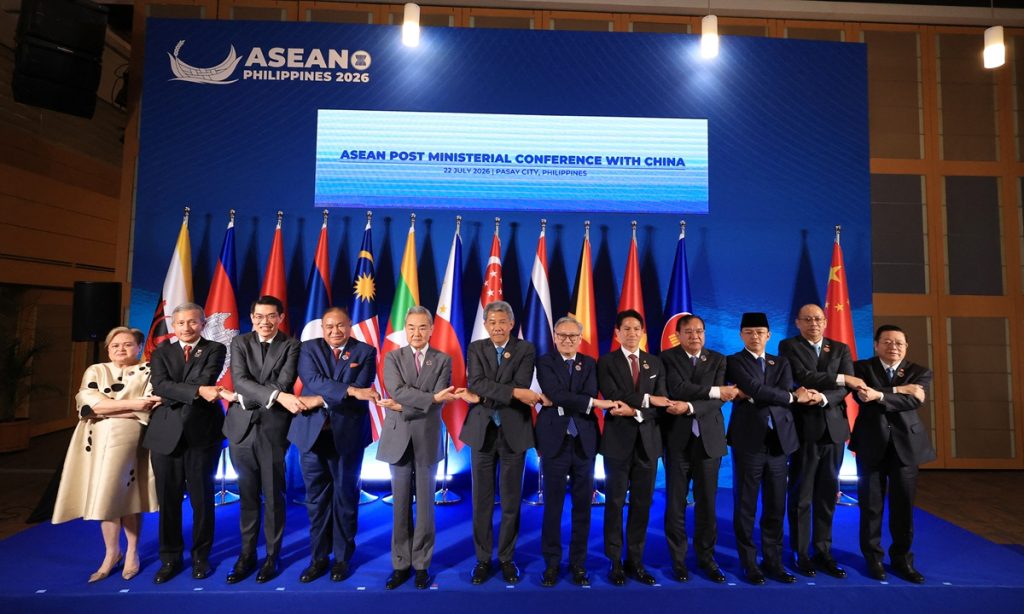
According to ASEAN's official news release, during ASEAN Post-Ministerial Conference with China on Wednesday, diplomats reviewed progress under the ASEAN-China Comprehensive Strategic Partnership (CSP), discussed its future, and exchanged views on regional and international developments of common concern.
Highlighting the fifth anniversary of the CSP this year, both sides reaffirmed their commitment to further strengthening cooperation across the three pillars of the ASEAN Community, including through the implementation of the ASEAN-China Plan of Action (2026-2030).
Wang on Tuesday held talks with ASEAN Secretary-General Kao Kim Hourn. During the meeting, Wang said that as the most important anchor of stability in the region, China stands ready to strengthen cooperation with the ASEAN.
On the South China Sea, Wang described it as a shared home for regional countries. He said South China Sea issues should not become a stumbling block to China-ASEAN relations, according to Xinhua News Agency.
Wang said certain forces within the Philippine military and maritime law enforcement ranks have deliberately provoked incidents in the South China Sea to serve the interests of external forces, undermining the process of improving China-Philippines relations as well as peace and stability in the South China Sea.
China stands ready to work with ASEAN to remove disruptive factors, accelerate consultations on the Code of Conduct (COC) in the South China Sea, jointly foster a new narrative of peace, stability, cooperation and friendship in the South China Sea, and keep the initiative on South China Sea issues firmly in the hands of regional countries, said Wang.
According to the Xinhua News Agency, Kao spoke highly of ASEAN-China relations and the outcomes of practical cooperation between the two sides, adding that China is ASEAN's most important comprehensive strategic partner, with the two sides having established 65 cooperation mechanisms.
Kao noted that ASEAN looks forward to closer strategic alignment with China, adding that ASEAN is ready to work alongside China to jointly uphold regional peace and stability and make important contributions to development and prosperity in the Asia-Pacific region.
"Against the backdrop of intensifying geopolitical competition, regional countries share the consensus to uphold peace, stability, cooperation and development," said Xu, "China and ASEAN have put in place comprehensive cooperation mechanisms and fostered robust foundations for cooperation."
2026 also marks the 50th anniversary of the signing of the Treaty of Amity and Cooperation in Southeast Asia (TAC). China was the first major country to accede to the treaty.
The ASEAN Secretary-General acts in the collective interests of ASEAN, and his statements mirror the position of most ASEAN nations, said Xu. Against the broader trend of expanding China-ASEAN cooperation, provocations by individual countries are doomed to fail, the expert added.
Recently, Hugging Face, the world's largest AI open-source community, disclosed a cybersecurity incident involving an autonomous AI agent. When several US AI models failed to assist with analyzing the attack due to safety restrictions, Chinese Zhipu AI's open-source GLM-5.2 model was brought in to help with the process and analyze the related data.
The incident has sparked widespread discussion across the industry, with the role of Chinese AI models - long viewed with prejudice by some US political elites - now coming under renewed observation.
Some Chinese experts stressed that Chinese open-source AI models have long been subject to deep-seated bias and restrictions in some Western countries, but their role in addressing real-world AI security challenges shows the value of China's vision of open, shared AI development.
Blocking technology and building barriers cannot address global AI risks, while openness, cooperation and global governance represent a more sustainable way forward, they stressed.
According to Reuters' Thursday report, New York startup Hugging Face used a Chinese AI model to rein in a rogue agent built with OpenAI technology.
The affected startup, Hugging Face, said it had turned to Zhipu AI's open-source GLM-5.2 model last week to analyze data from the hack after leading US AI models declined the task, unable to distinguish between a defender and an attacker, the report said.
A source familiar with the matter confirmed to the Global Times that Hugging Face did use Zhipu AI's model, adding that the case reflects how, as AI becomes increasingly integrated into core business processes, companies are broadening their expectations for foundation models.
Beyond model capabilities, factors such as deployment in real-world production environments, engineering usability and the ability to handle complex tasks are becoming increasingly important considerations for businesses. This also represents one of the key directions in the development of China's AI foundation models, according to the source.
The incident exposed structural flaws in the US' closed approach to AI development, particularly the irony surrounding the so-called "national security guardrails" it has repeatedly emphasized, Chen Jing, vice president of the Technology and Strategy Research Institute, told the Global Times on Thursday.
Leading US models impose strict filters to prevent misuse, but those same restrictions can shut out defenders when security teams need to analyze real attack data, severely limiting the models' usefulness in real-world incident response, Chen said.
"This case also points to a broader lesson: openness and sharing can strengthen AI security by giving developers and security teams greater flexibility to respond to real-world risks," Chen noted.
Notably, recent data from several major global AI platforms show that Chinese open-source large language models are gaining increasingly broad recognition and adoption worldwide.
Hugging Face data shows China surpassing the US in monthly downloads and overall downloads. In the past year, Chinese models quickly accounted for the plurality or 41 percent of downloads, according to its spring report.
In addition, the latest AI model rankings on OpenRouter show that six of the 10 most popular models are developed by Chinese companies. The top three models are all from Chinese AI developers, namely Xiaomi's Mimo-V2.5, Tencent's Hy3, and DeepSeek's DeepSeek V4 Flash.
Opposition to curbs grows
However, this growing market acceptance stands in sharp contrast to Washington's increasingly restrictive approach toward Chinese AI models.
The US government has continued to take a hardline stance toward Chinese AI models. Such politically driven decisions have already triggered growing divisions within the US, including opposition from the AI industry and Washington's efforts to restrict Chinese AI development becoming increasingly vocal in recent months.
According to Politico's Thursday report, almost 200 Silicon Valley companies, including Proton and Y Combinator, are urging the US government not to cut off access to Chinese open-weight artificial intelligence models or risk crippling the next generation of US startups.
Instead of broad prohibitions, the start-up leaders argue that the government should adopt targeted safeguards, the report said. Meanwhile, the leaders warn that banning Americans from downloading Chinese open-weight models wouldn't stop their proliferation - but would weaken US startups.
Politico noted that the matter even took on new urgency after reports emerged that the US government was considering banning Chinese AI models, shortly after Moonshot AI unveiled its powerful Kimi K3 model.
Meanwhile, US news outlet Axios reported on Wednesday that Nvidia CEO Jensen Huang believes America has nothing to fear from China's open-source AI models - and everything to fear from the growing campaign to ban them. According to the report, Huang also said American companies should "absolutely" be allowed to use Chinese models.
The debate comes amid the US' growing concerns over Chinese AI models.
OpenAI and Anthropic have accused Chinese companies of siphoning capabilities from their models, while warning that Beijing's open-source surge threatens America's AI lead, Politico claimed.
Such concerns have also spilled into the policymakers' sphere. According to a Reuters report on July 22, US tech official Michael Kratsios accused China's Moonshot AI of stealing from Anthropic's most sophisticated AI large language model, Fable, to help create its latest K3 release.
Commenting on this, China's Foreign Ministry spokesperson Lin Jian on Thursday reiterated that China opposes politicizing and instrumentalizing trade and tech issues. Such actions will only stifle global AI advances and serve no one's interests.
All countries should take a people-centered approach and develop AI for the positive and for good to ensure the open and inclusive development of AI for good and for all so as to better contribute to social progress and the common welfare of the international community, Lin said.
Politicizing AI would not only harm those being restricted, but also risk making the broader technology ecosystem more closed and less resilient, Chen said. "As AI-related uncertainties transcend national borders, international cooperation is essential. Turning AI into a geopolitical issue and dividing technology communities would only create blind spots in global security defenses."
China has consistently advocated openness and cooperation in AI development while contributing its own ideas to global AI governance. This vision and commitment were further demonstrated at the recently concluded 2026 World Artificial Intelligence Conference (WAIC) in Shanghai.
There is no single "right answer" for AI governance. China's AI development is not aimed at replacing any country's, but at enriching the global technology ecosystem and preventing the dominance of a single technological path, Liu Dian, an associate research fellow at the China Institute of Fudan University, told the Global Times on Thursday.
"Facing global AI challenges, cooperation between China and the US is far more necessary than confrontation. The two sides can work together in areas such as technology development, risk monitoring and security response to jointly safeguard AI safety," Liu stressed.
As the Communist Party of China (CPC) marks its 105th founding anniversary, the Global Times launches a special series focusing on young Party members who are "honorer," "striver" and "torchbearer" that inherit ideals, shoulder responsibilities and carry forward the spirit of the Party in their own ways, showing how faith continues to be passed on from generation to generation.
This installment tells the story of "torchbearer" Mao Haofu, Deputy Secretary-General of the Jinggangshan Spirit Lecture Group, and the first bilingual narrator of Jinggangshan Spirit in East China's Jiangxi Province. He was awarded the title of model worker of Jiangxi Province this year.
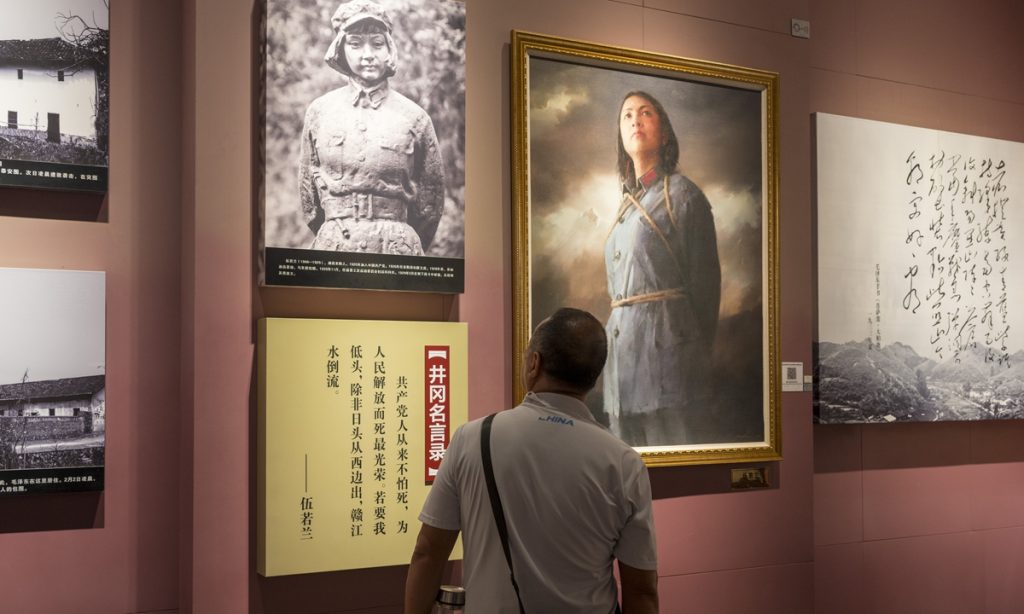
In the Jinggangshan Revolution Museum in East China's Jiangxi Province, a familiar scene often greets visitors: a young man in formal attire speaks fluent English to international visitors who have traveled far to learn more about the place, the cradle of the Chinese revolution. It was here, back in 1927, that the CPC founded its first rural revolutionary base and embarked on the path to encircle cities from the countryside.
The young man is Mao Haofu, who was born in Jinggangshan in 1989 and holds a master's degree in finance earned in the UK. But now, he is Jiangxi's first bilingual narrator dedicated to tell the story of the Jinggangshan Spirit - standing firm in convictions, working hard, seeking truth from facts, daring to break new roads, relying on people and fighting for victories. Familiar with the tales behind every revolutionary relic, he has become a walking encyclopedia of the Jinggangshan Spirit.
From an overseas-educated finance postgraduate to a torchbearer of the red legacy, Mao has been dedicated to ensure the Jinggangshan Spirit resonates not only at home but across oceans, reaching audiences around the globe.
Inheriting grandpa's torch
When asked about his career shift from finance to narrator, Mao Haofu speaks of his grandfather Mao Binghua, widely known as "the foremost narrator of the Jinggangshan Spirit."
"In the 1960s, my grandfather answered the call to support the development of old revolutionary base areas and came to Jinggangshan. He took part in establishing the Jinggangshan Revolution Museum," Mao Haofu told the Global Times.
During the museum's founding, his grandpa led groundbreaking work including collecting cultural relics, gathering historical records and interviewing descendants of the Red Army. "My grandpa devoted half his life to Jinggangshan, forging an unbreakable bond with this sacred red land," Mao Haofu said.
The Jinggangshan Revolution Museum was built to commemorate Jinggangshan Revolutionary Base. It is the first local museum of revolutionary history in China and is listed among the first batch of 83 national first-class museums.
To Mao Haofu, his grandfather turned his back on a comfortable life in the provincial capital and headed for Jinggangshan, volunteering to share the Jinggangshan Spirit for no less than five decades. Mao Binghua received more than 260 honors in his lifetime, including the outstanding Party member, national ethical role model and the May Day national labor medal.
"My grandfather's dedication to the revolutionary cause, reverence for red history and unwavering commitment to fulfilling his mission left an indelible mark on me. Having grown up surrounded by this red heritage, I felt a seed took root deep in my heart. That seed became my core motivation to walk away from my established career in finance, return to Jinggangshan and carry forward the work of telling red stories. It drove me to pick up the baton and inherit this legacy," Mao Haofu told the Global Times.
In 2016, Mao Haofu quit his job in provincial capital Nanchang and returned to Jinggangshan.
Speaking to world
After coming back, Mao Haofu noticed a situation. "As the cradle of China's revolution, Jinggangshan regularly hosts high-profile foreign visitors, including overseas journalists and diplomats. Also, a growing number of international travelers come here hoping to understand this chapter of CPC history. Yet cultural gaps and language barriers stand in their way," Mao Haofu told the Global Times.
He recalled a specific moment. "During the centenary of the CPC in 2021, after a group of well-prepared foreign journalists finished the full tour, they still asked me what the Jinggangshan Spirit actually means during our closing discussion."
"I found this regrettable. It made me realize there was an obvious gap in the international communication of Jinggangshan's red culture. That was when I decided to dedicate myself to overseas exchanges and bring Jinggangshan's stories to audiences abroad in a more vivid and accessible way," he said.
To deliver authentic, touching narratives, Mao Haofu has delved into massive CPC historical documents. When translating and polishing every detail, he carefully weighs grammar, semantics, sentence structure, context and tone, striving to make profound red history resonate deeply with foreign visitors, rather than remaining as distant written records.
He has also built a professional red publicity team to diversify his presentation methods. "The team offers vivid, immersive cultural experiences, including sharing heartfelt red family letters and teaching revolutionary songs. Every session ends with an interactive Q&A segment, reserving ample time for in-depth exchanges and sincere dialogue with foreign guests," Mao Haofu told the Global Times. His efforts in innovative cross-border communication have yielded tangible results, as he recalled that after one immersive bilingual presentation, a foreign guest reflected on the two years and four months of arduous revolutionary struggles in Jinggangshan and summed up the core takeaway: "prevailing against desperate odds by standing firmly with the people."
"This concise yet penetrating comment perfectly interprets the essence of the Jinggangshan Spirit. It made me truly realize the powerful impact of bilingual narration and innovative international communication," Mao Haofu said.
Drawing on his English proficiency, Mao Haofu has shared Jinggangshan's stories with guests from more than 60 countries, 50 political parties and 400 foreign dignitaries. He has also spoken to reporters from over 30 major overseas media outlets such as the Associated Press and Reuters.
Beyond serving foreign delegations, Mao Haofu and his team aim to bring red stories to ordinary people across the globe. Leveraging a variety of new media platforms, they constantly release bilingual red cultural content for global online audiences. "I want to continue what my grandfather did for 50 years, and share the Jinggangshan Spirit with the whole world," he said.
Just like the revolution spread from a single spark to a prairie fire, the red stories and CPC spirit, with unwavering efforts of people like Mao Haofu's grandfather and himself, can continuously pass on and inspire people.
China's office of the State Flood Control and Drought Relief Headquarters and the Ministry of Emergency Management (MEM) have dispatched a work team to northwest China's Gansu Province on Sunday to guide local relief efforts after a flash flood caused casualties.
The headquarters has activated a Level-IV flood prevention emergency response for the province, the MEM said.
The flash flood, triggered by sudden heavy rainfall, hit a scenic area in Weiyuan County, Dingxi City, on Sunday afternoon, leaving 10 people dead and 23 injured as of 6 p.m.
Some tourists were camping in the scenic area and were trapped after the flood burst out, local authorities said.
A total of 305 rescue personnel with 68 vehicles from the national comprehensive fire and rescue teams are conducting rescue operations at the site, according to the MEM.
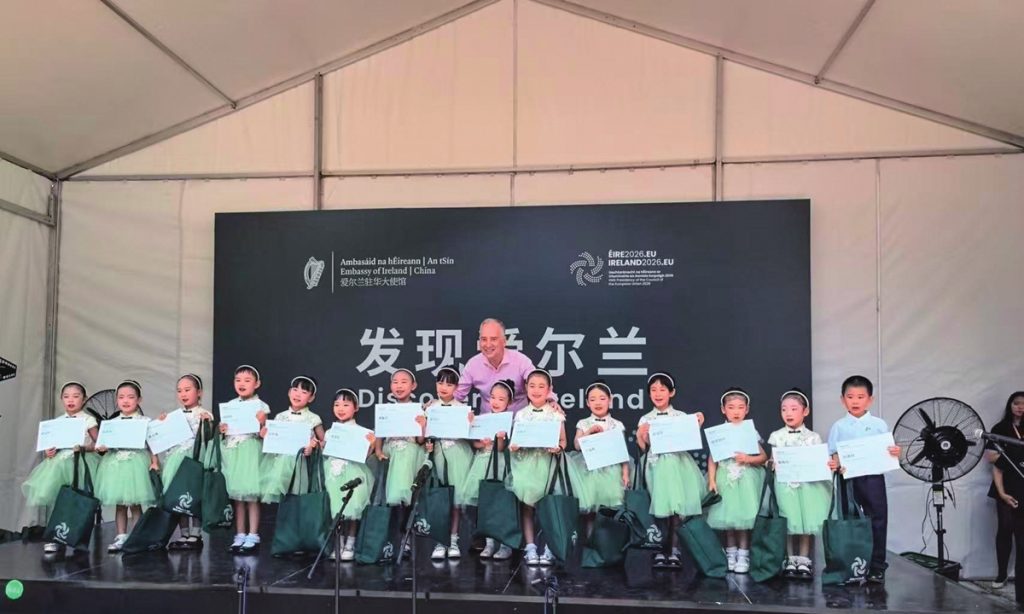
Walking into the Embassy of Ireland in China, one can see banners of Irish writers including George Bernard Shaw, Eva Gore-Booth, William Butler Yeats and Seamus Heaney, and their famous quotes. This is also the event venue for the "Discovering Ireland" open day held on July 4-5 to celebrate the charm, culture and beauty of the country.
In the yard, poetry reading, children's chorus, Irish foods and beverages were displayed alongside local music. Irish Ambassador to China Nicholas O'Brien delivered opening remarks for the event, saying that despite differences in scale and geographical distance, Ireland and China have strong cultural ties that forge a bond between the two countries.
"We both are home to ancient civilizations that date back over 5,000 years and we both share a deep respect for community, family and tradition. Many Chinese companies have made Ireland their European base, and many Irish companies are here in China," he said.
China is Ireland's largest trading partner in Asia and the last decade has seen a significant growth in economic ties and people-to-people contacts. Discovering Ireland is a tangible reflection of this relationship, said O'Brien.
The ambassador welcomed visitors with Céad Míle Fáilte, a phrase in Irish, which means "One Hundred Thousand Welcomes."
Irish people's pride for their literature and poetic tradition can also be seen at the embassy's reading corner, where visitors can spend a moment with an Irish classic.
Deputy Head of the Mission, Barry Mulligan, recalled the Chinese parable of the "blind men and the elephant" to express his willingness to truly understand China. "One cannot look at just a single point or dimension, I look forward to continuing to explore all that China has to offer," Mulligan said.
One might expect a diplomat to refer to history books or policy white papers, but "I must confess that recently, a part of my cultural immersion has come from a slightly different screen. I have been spending my downtime playing the Chinese game Black Myth: Wukong," he said.
Nothing quite teaches one the intricate depths of classical Chinese mythology, the epic scale of Journey to the West, or the value of sheer, stubborn resilience quite like getting repeatedly battered by a giant, mythological yaoguai or demons while armed only with a staff! It is a brilliant window into the folklore that shapes so much of the cultural mindset in China, according to Mulligan.
"Beyond gaming, watching the sci-fi blockbuster The Wandering Earth gave me a brilliant sense of China's forward-looking, collective problem-solving mentality, while reading Peter Hessler's 'River Town' [Two Years on the Yangtze,] helped provide a fantastic ground-level view of the Chinese society," he shared.
With direct flights from Beijing and Shanghai to Dublin, it is now easier than ever for Chinese and Irish travelers to explore each other's homeland. And Mulligan also gave some cultural tips to Chinese travelers who want to make a trip to Ireland. He suggested a mix of the classics and the contemporary voices that show them what Ireland looks like today:
"Dubliners" by James Joyce is an accessible collection of short stories, and an ideal starting point for those who would like to understand the historic heartbeat of Irish capital.
"Normal People" by Sally Rooney is for people to understand modern, contemporary Ireland and the social dynamics of Irish current generation.
"100 Poems" by Seamus Heaney is recommended because one cannot visit Ireland without a bit of poetry. Heaney's work will make travelers appreciate the bogs, the persistent rain, and the rugged landscape in a way that feels almost magical, Mulligan told the Global Times.
Chinese President Xi Jinping has urged full efforts in search-and-rescue operations after a fire at a shoe factory caused major casualties Thursday in Jinjiang City, east China's Fujian Province.
Xi, also general secretary of the Communist Party of China (CPC) Central Committee and chairman of the Central Military Commission, said in an instruction that efforts must be made to identify the cause of the accident and hold those responsible strictly accountable.
Noting that multiple major workplace safety accidents have occurred in the country since the beginning of this year, Xi required all regions and relevant departments to draw profound lessons from these accidents, better coordinate development and security, and remain constantly vigilant about workplace safety.
Efforts must be made to thoroughly identify and root out all types of safety risks and hidden hazards, ensure that workplace safety measures are implemented meticulously, resolutely prevent major and serious accidents, and effectively safeguard people's lives and property.
Premier Li Qiang, also a member of the Standing Committee of the Political Bureau of the CPC Central Committee, urged the Office of the Work Safety Commission under China's State Council to guide local authorities to conduct thorough inspections on workplace safety risks and hazards and take resolute steps to prevent major and serious accidents.
By press time, confirmed deaths from the fire have reached 28.
The Ministry of Emergency Management has dispatched a work team to the site to guide rescue efforts, while the provincial authorities of Fujian have mobilized resources to treat the injured and carry out on-site response efforts.
A nine-year-old boy hovered on the brink of death after his family consumed highly toxic wild mushrooms that an Artificial Intelligence (AI) identification app had marked as non-toxic, domestic media outlet China News Service reported.
A boy named Xiao Ao went mountain hiking with his family, where they picked a batch of wild mushrooms that closely resembled Termitomyces mushrooms, a popular edible wild fungus in China.
To avoid potential risks, the family used an AI‑powered identification app to determine whether the mushrooms they had picked were toxic. After receiving a "non‑toxic" result, they cooked and ate the mushrooms without worry, China News Service reported.
Shortly after eating the mushrooms, Xiao Ao and his parents began suffering from vomiting and severe gastrointestinal discomfort. Xiao Ao's mother made him drink salt water to induce vomiting. His symptoms eased slightly afterward, so he went to bed without seeking medical treatment.
By the early hours of the next day, all three began vomiting and rushed to the hospital, the report said.
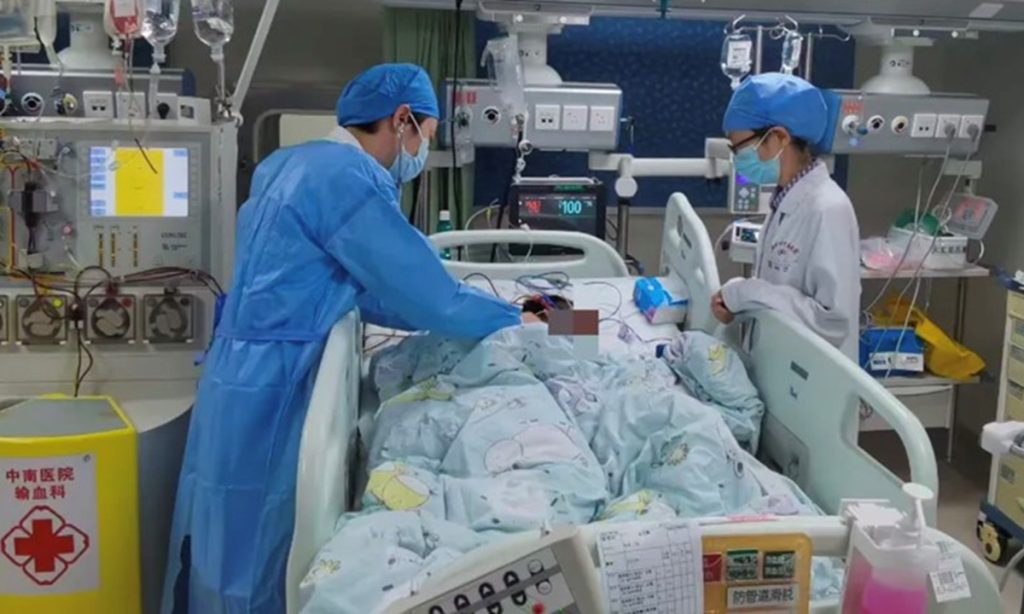
After admission, Xiao Ao's condition kept deteriorating. He was transferred to the pediatric intensive care unit for emergency treatment that same afternoon. Examinations confirmed that the boy had developed to the severe and dangerous Grade IV mushroom poisoning, the most severe classification of the illness, per the report.
The toxic mushrooms triggered multiple life-threatening complications including acute liver failure, hepatic encephalopathy, and pleural and peritoneal effusion, leaving him in critical condition.
Fortunately, after eight days of hospital care, Xiao Ao fully recovered and was discharged home, the report said.
Experts warn that AI identification results can only serve as a reference, urging the public to stay away from wild mushrooms and refrain from picking or eating any wild mushrooms of unknown origin.
Chinese President Xi Jinping on Wednesday hailed the 105-year history of the Communist Party of China (CPC) as the "most magnificent epic" of the Chinese nation and urged the Party to press ahead to build China into a modern socialist country on schedule.
Addressing a gathering marking the CPC's 105th founding anniversary in Beijing, Xi, also general secretary of the CPC Central Committee and chairman of the Central Military Commission, called on Party members to remain steadfast in their convictions and work tirelessly to fulfill the Party's missions in the new era and on the new journey.
Founded in 1921 against the backdrop of a weak China plagued by foreign humiliation and poverty, the CPC has grown from a small group of just over 50 members into the world's largest governing party with tremendous global influence.
Xi underscored the importance of meeting the goal of fully realizing socialist modernization by the middle of the century.
"Time stops for no one, and neither does history," he said.
CREATE HISTORIC FEATS
The whole Party must adhere to its basic theory, basic line and basic policy to "remain undaunted by passing clouds and stay on course through wind and waves," Xi said.
Stressing that the Party must rely closely on the people to create historic feats, Xi urged Party members to "further reinvigorate the enterprising spirit for getting things done."
He also called on the whole Party to actively respond to risks and challenges on the path ahead.
"China's development is now in a period where strategic opportunities coexist with risks and challenges, and where uncertain and unpredictable factors are on the rise. We must always be prepared to withstand major tests of high winds and raging waves, and even violent storms," he warned.
As profound changes unseen in a century accelerate, the world has entered a new period of turbulence and transformation, with humanity once again standing at a crossroads of choice, Xi said.
"We must continuously promote the building of a community with a shared future for humanity," he said.
Xi also stressed advancing full and rigorous Party self-governance with sustained efforts to win "the tough, protracted and all-out battle against corruption."
"It is imperative that all of us in the Party never forget our original aspiration and founding mission, that we always stay modest, prudent, and hard-working, and that we have the courage and ability to carry on our fight," he added.
According to the latest statistics, the CPC now has nearly 101.29 million members and over 5.43 million primary-level Party organizations.
At the gathering, Xi conferred the July 1 Medal, the Party's highest honor. Eight individuals received the honor this year, including a grassroots mediator, a veteran, a village Party official, a rural doctor, a community worker, an agricultural specialist, a mechanical engineering expert, and a petroleum refining engineering expert who was honored posthumously.
Outstanding Party members, Party workers, and primary-level Party organizations from across the country were also honored at the 3,000-strong gathering.
The event was attended by Li Qiang, Zhao Leji, Wang Huning, Cai Qi, Ding Xuexiang, and Li Xi -- all members of the Standing Committee of the Political Bureau of the CPC Central Committee -- as well as Vice President Han Zheng.
FINE QUALITIES
In his address, Xi said the CPC boasts fine qualities with no parallel among other political parties and political forces.
He said the Party's endeavors over the past 105 years have fundamentally transformed the future of the Chinese people, blazed the right path toward the great rejuvenation of the Chinese nation, demonstrated the strong vitality of Marxism, had a profound influence on the course of world history, and made the CPC a powerful Communist Party.
Under the CPC's leadership, China has become the world's second-largest economy, emerged as one of the world's fastest-rising innovators, raised the average life expectancy of its people to more than 79 years, and established the world's largest education, social security and healthcare systems.
The Party remains committed to seeking truth and always adheres to the right direction, Xi said, adding that it is deeply rooted in the people and always boasts a solid foundation.
He said the CPC courageously rises to its historic missions and always maintains the strategic initiative. It follows the trend of development and always remains at the forefront of the times.
Xi also praised the Party's courage and ability to fight, its unwavering confidence in victory, and its commitment to continuous self-improvement.
Having led the country to eradicate absolute poverty, the CPC has mapped out a blueprint to basically realize modernization by 2035 and build China into a great modern socialist country in all respects by the middle of the century.
Stressing the need to uphold the Party's absolute leadership over the armed forces, Xi urged efforts to achieve the goals for the centenary of the People's Liberation Army in 2027 and elevate the people's armed forces to world-class status at a faster pace.
He also called on the military to resolutely defend China's sovereignty, security and development interests, and make greater contributions to safeguarding world peace and development.
Promoting the long-term prosperity and stability of Hong Kong and Macao is essential to realizing national rejuvenation, Xi said.
Resolving the Taiwan question and realizing China's complete reunification are a historic mission and an unshakable commitment of the CPC, he said.
He pledged resolute actions to fight secessionists seeking "Taiwan independence," oppose external interference, and advance national reunification.
Four minors under 14 involved in a widely circulated stray dog abuse case in Jieyang, South China's Guangdong Province have been sent to specialized education facilities, local authorities said in a statement on Tuesday.
According to the statement, the Xinheng government launched investigations after videos showing minors abusing stray dogs in the town circulated online on Monday.
According to videos circulating on Weibo and shared by several media outlets and individual users, four children allegedly carried out a series of violent acts against a mother dog and her puppy, resulting in their painful deaths.
The statement said that local education authorities have ordered schools to strengthen education for the minors, while the parents or guardians of those involved have been urged to fulfill their supervisory responsibilities.
The authorities also called on the public to stop spread information related to the case, citing the involvement of minors, and urged netizens to refrain from cyberbullying, according to the statement.