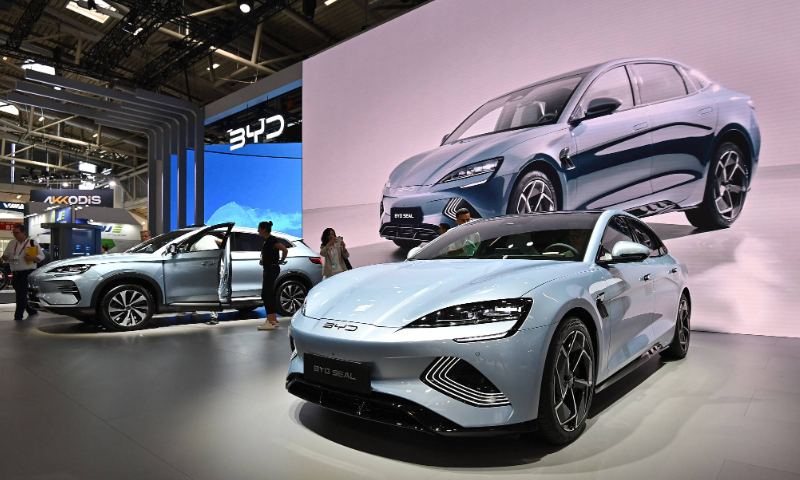
Chinese electric vehicle giant BYD released its brand-new intelligent architecture, Xuanji, on Tuesday, with observers saying it represents the latest effort of Chinese carmakers to gear up for transformation in the global auto intelligence race, which is seen as key factor in the next round of competition in the high-end vehicle market.
China's auto industry hit a new milestone in 2023, with record production and sales. The country is also expected to dethrone Japan as the world's top vehicle exporter.
Xuanji is a whole-vehicle intelligent structure that is composed of a self-developed smart brain, a dual artificial intelligence (AI) large model both inside the vehicle and in the cloud - also the industry's first AI large model application in whole vehicle - as well as four "chains" including sensor, controller, data and mechanical systems. The architecture could eventually be connected to three networks including internet of vehicles, 5G and satellite network.
The structure enables dynamic adjustments to various hashrate modes in accordance with demand, and thus would allow a seamless switch between different modes and accommodation to future algorithm models.
At the press briefing in Shenzhen, South China's Guangdong Province where BYD is headquartered, the company also unveiled an unmanned aerial vehicle (UAV) system that has been jointly developed with Chinese drone-maker DJI. It supports functions such as taking off and landing with a press of a button, as well as intelligent charging.
BYD said at the press briefing that its accumulation at the electric field has laid a solid foundation for its intelligent drive, which is "the second half court battle in the new energy race."
The company also presented a number of what it claims to be revolutionary intelligent driving techniques during a media tour on Tuesday. For example, in terms of smart parking, it only took 25 seconds for BYD's intelligent driving system to complete parking at a designated space, whereas it took a veteran driver a minimum of 30 seconds to finish the same process.
The Global Times also took a ride in a BYD vehicle using the "Navigate on Autopilot" (NOA) function on Tuesday. During a 45-minute ride, the vehicle deployed multiple autonomous functions in its drive in downtown Shenzhen, such as automatic traffic light identification, automatic steering at road junctions, and autonomous overtaking as well as yielding to pedestrians and two-wheeled vehicles.
A number of other Chinese companies including Huawei, Nio, Xpeng, and Li Auto have released NOA systems tailored for city driving since the beginning of 2023. In the first half of 2023, a total of 209,400 vehicles equipped with NOA were delivered, up 108.98 percent year-on-year, data released by Kaiyuan Securities showed.
It is expected that the number will rise by 141.43 percent to 1.69 million units in 2024, said another report by Western Securities.
BYD received a testing license for level 3 (L3) autonomous driving on high-speed roads in Shenzhen in July 2023. The company said it was the first to be granted such a license in China.
As NEV costs are expected to ease this year due to the mass production effect, building advantages in intelligent systems will help Chinese automakers in the high-end international market, industry observers pointed out.
One industry insider, who spoke on condition of anonymity, told the Global Times on Tuesday that while China has a manufacturing edge, there's still a gap between Chinese and foreignfirms in certain intelligent techniques such as autonomous driving technologies, partly because of the foreign firms' first-mover advantage that helped their companies to collect a lot of vehicle data.
"The NOA systems developed by Chinese companies still face a bunch of barriers as the road situation in China is sometimes more complicated than in overseas countries. And Chinese companies arescaling up efforts to accelerate the catch-up process," the insider explained.
China's car output exceeded 30.16 million units in 2023, up 11.6 percent year-on-year, and sales exceeded 30.09 million units, up 12 percent, according to data released by the China Association of Automobile Manufacturers (CAAM). Both output and sales set new records, according to the CAAM.
Editor's note: China's economy overcame numerous internal and external challenges last year, achieving 5.2 percent expansion and surpassing the target set at the beginning of the year. In the face of tests such as weak external demand, it wasn't easy for the Chinese economy to reach this level of recovery in the first year after the three-year pandemic.
However, Western critics who constantly underplay China's hard-won economic achievements are again trumpeting "China economic collapse" narrative. The Global Times (GT) invited Gary Hufbauer(Hufbauer), a non-resident senior fellow at US think tank Peterson Institute for International Economics, to share his perspectives on China's economic performance in 2023 and its economic outlook in 2024.
GT: China's GDP grew 5.2 percent year-on-year in 2023, higher than the target of about 5 percent, data from the National Bureau of Statistics (NBS) showed on Wednesday. How do you view the growth rate in 2023, the first year of the post-COVID recovery?
Hufbauer: The 5.2 percent growth figure for China's economy in 2023 is a strong number, given the size of the Chinese economy, its state of development and the weak outlook for global growth. I sharply disagree with critics who say the Chinese economy is stumbling.
GT: How do you view the current economic situation in China? How do you evaluate China's economic prospects in 2024?
Hufbauer: In my view Chinese prospects in 2024 are good. Beijing can certainly manage dislocations in the property market and prevent any sort of financial crisis. Expansionary fiscal and monetary policies can avert the threat of deflation. China's economic challenges are modest compared, for example, with the challenges facing the EU.
GT: China remains an important engine driving world economic growth. The IMF's senior resident representative in China predicted that the Chinese economy will maintain a sound growth in 2024 and continue to account for one-third of global economic growth. How do you view the global significance of the steady and positive development of the Chinese economy?
Hufbauer: The world economy depends on strong Chinese growth, and that looks assured for 2024. If Chinese growth dropped to 2 percent, as expected for the US, and even less for the EU and Japan, the world outlook would be dismal.
GT: Global growth is projected to slow for the third year in a row - from 2.6 percent last year to 2.4 percent in 2024, the World Bank said. In a world battling many uncertainties, how should major economies jointly tackle challenges and promote global growth rather than politicizing economic issues?
Hufbauer: World leaders should welcome globalization and avoid new trade or investment restrictions. Unfortunately that's not happening in Europe, the US, India and several other places. This is an arena where China can lead.
GT: How should the largest economy in the world - the US - further improve its economic cooperation with China - the second-largest - to provide more certainty and positive energy for the global economy?
Hufbauer: The US should stop the search for new national security risks arising from trade and investment with China, and instead search for new areas of mutual economic gain. Many barriers can be reduced with no harm to the national security of the US or China.
GT: China sent only 45 percent of its exports to the developed economies including the EU and the US in November, figures from data provider CEIC showed. The decline in trade between China and Western countries in November reveals that the reality of "de-risking" is concerning, according to the WSJ. What's your perspective on "de-risking"?
Hufbauer: "De-risking" has gone far enough. "China hawks" in the US Congress want to expand "de-risking" until it reaches "de-coupling." This is misguided, and can only result in dividing the world economy into a China bloc and a US bloc.
A two-bloc world will depress global growth. Moreover, many countries in Asia, Latin America and Africa reject the idea that they should show primary allegiance to one bloc or the other.
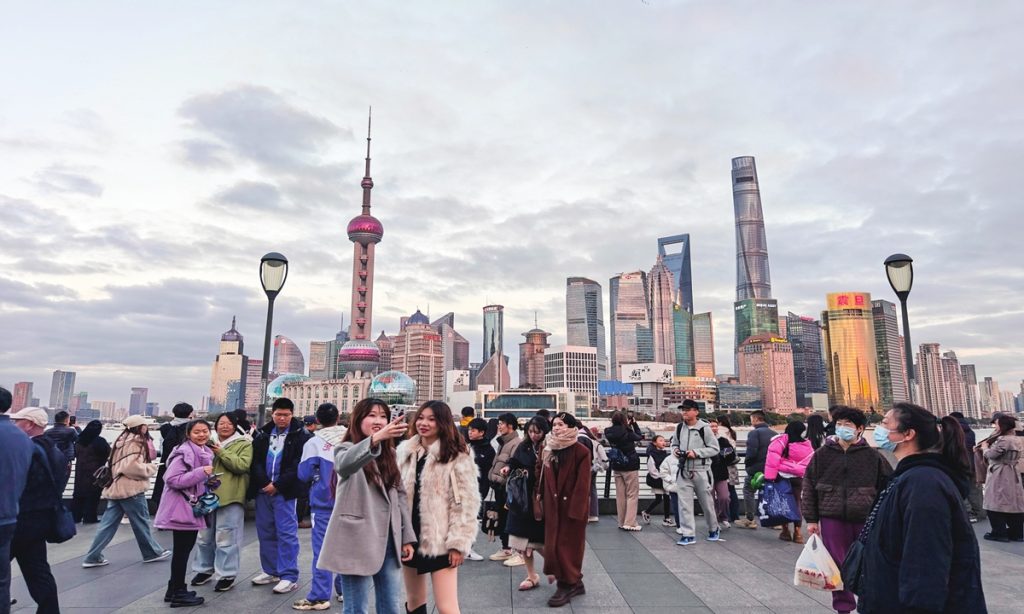
Including inviting Chinese superstars like Xiao Zhan and Wang Yibo to introduce their hometowns, a cutthroat competition has seemingly recently started among several culture and tourism bureaus across the country, which are tactfully transforming "star power" into a new advertising mechanism for provinces and cities to boost local tourism.
The competition is currently white-hot. So far, provinces like Hubei, Shandong, Hebei and Jilin have all found tourist ambassadors like actors Zhu Yilong and Huang Xiaoming. Take Wang Yibo's home province of Henan as an example. Its provincial-level bureau of cultural tourism has been posting around 20 to 30 promotional videos per day on sites like Sina Weibo since January 10. Hebei Province has invited leading actress Zhao Liying as a promoter.
What has made these local tourist organs so "desperate" to show off all of a sudden? The question has a clear answer - the approach of the Spring Festival holiday season in early February, a period that Zhu Jiaming, a tourist market analyst, describes as the "golden annual travel peak."
"Market growth during this time can surge to even three times than usual. It is an opportunity that cannot be missed," Zhu told the Global Times.
If embracing as many visitors as possible is the common goal of tourist destinations, then why turn popular celebrities as a promotional strategy?
The answer to this question is simple - superstars can quickly bring views on social media. For example, on Monday, Xiao Zhan's video to promote his hometown Chongqing became a trending topic earning around 120 million views. The popularity of the video only increased when netizens posted it in fan groups.
"I've shared the link with fans I know in Xi'an and Changsha. We have already formed a tour group to Chongqing and have around eight people on board," Chen Mengxi, a 24-year-old fan in Shanghai, told the Global Times.
Another reason the "celebrity strategy" to boost tourism appears to be powerful is that it can instantly click with the interests of young people, a consumer group that makes up "at least 40 percent of tourism growth," Zhu said. Celebrities like Wang Yibo saying "I'm waiting for you in Luoyang" seems to be a clever psychological maneuver that attempts to establish an intimate connection between visitors and the star.
"I decided to visit Luoyang because I want to see where Yibo grew up," a netizen posted on Sina Weibo.
While we can only see how much this star power has paid off after seeing actual seasonal data, this approach nevertheless is positive as it reveals a celebrity's power to better social growth while also rejuvenating old-fashioned marketing in the current tourism industry. As a famed star, one carries the responsibility to deliver positive social messages. Their supports to society can be reflected from different aspects, and tourism is only one of them.
The contribution of star power to the tourist industry is indeed important, yet what is most essential is whether or not a city or a province is sufficiently prepared to embrace all the visitors brought by a celebrity's fame.
In other words, every tourist destination should pay more attention to improving their tourist resources and facilities and the quality of their services to cater to visitors. The true development of a location's tourism should match the value of the star power that seeks to promote it.
Just like the bygone year of 2023, 2024 is going to see another boom in China's tourist industry. According to data revealed by the China Tourism Academy (Data Center of the Ministry of Culture and Tourism), it is expected that the number of domestic tourists and domestic tourism revenue will exceed 6 billion people and 6 trillion yuan respectively in 2024.
"We anticipate that new promotional strategies and patterns will emerge from the huge promising market in 2024," Zhu told the Global Times.
In the face of the major opportunities and challenges brought about by a new wave of technological revolution and industrial transformation, innovation has become a topic of particular concern for all countries as it is a key factor in pushing forward a country's continued development.
In September 2023, the World Intellectual Property Organization (WIPO) released the "Global Innovation Index (GII) Report 2023." The report showed that China, Turkey, India, Vietnam, the Philippines, and Indonesia are the middle-income economies that have made the most headway in innovation over the last decade. Among them, China is the only one that ranked among the top 30.
"China is far ahead in global innovation performance; it is close to the top 10 of the GII ranking and still the sole middle-income economy within the GII top 30," Sacha Wunsch-Vincent, head of the section of Economics and Statistics Division, and co-editor of The GII at the WIPO, told the Global Times in an exclusive interview.
A close look at the GII reports revealed that since the first release of the GII report in 2007, China's overall ranking has shown a steady upward trend. In this year's ranking, China ranks 12th, having climbed 31 spots from its lowest ranking in previous years (43rd in 2010). The report also specially mentioned that China is the only middle-income economy among the top 30, followed by Japan in the 13th place.
Steady progress in innovation
Data in the GII report showed that in 2023, China ranked first globally in six specific indicators, including the proportion of creative goods export in total trade volume, domestic market scale, labor productivity growth rate, PISA scales in reading, math, and science, the ratio of trademarks by origin to GDP, and the ratio of utility models by origin applications to GDP.
"The GII rankings are compiled based on about 80 indicators which can be gleaned from the country profiles. The indicators are structured around innovation input and innovation output dimensions and cover fields such as human capital, research and development, venture capital, high-tech manufacturing, and patents, but also rank intangible assets and creative goods and services," Wunsch-Vincent explained.
A special excerpt from the GII also showed that the world's five biggest science and technology (S&T) clusters are now located in East Asia, with China emerging as the country with the greatest number of clusters as Tokyo-Yokohama leads as the biggest S&T cluster.
"The emergence of Chinese top science and technology clusters does not come as a surprise with all the science and innovation activity that has propelled China forward in the GII. It is impressive nonetheless - some of the top-ranked cities or regions are obvious leaders such as around Beijing or Shanghai," Wunsch-Vincent noted to the Global Times.
"In addition, there are many cities or clusters emerging, which are new and not that well-known yet as science and technology hubs around the world. In that sense, the ranking also allows the rest of the world to better understand the geography and potential of innovation in China," he said.
Feng Xingke, secretary general of the World Financial Forum and director of the Center for BRICS and Global Governance, told the Global Times that this reflects the shifting of the global center of technological activities to the East, with East Asia leading global technological innovation.
"The increase in the number of Chinese technology clusters is mainly due to China's continuous strengthening of regional technological innovation development strategies in recent years, forming an ecological system for technological innovation with central coordination, local healthy competition, and mutual development," Feng said.
Analysts generally believe that China has made remarkable achievements in the fields of new energy, high-speed rail, modern information, new materials, and artificial intelligence, and related new industries and products have shown strong growth momentum.
Feng pointed out that one important reason for China's innovation progress lies in the strong support from the government.
In recent years, the Chinese government has invested a large amount of funds in major scientific and technological innovation research and development, and has provided a favorable policy and business environment for scientific and technological innovation, strengthened the team of scientific and technological innovation talents, and laid a solid foundation for technological innovation progress, he said.
In a previous interview with the Global Times, Manuel C. Menendez, founder and CEO of MCM Group Holdings, hailed the great achievements that China has made over the last decade.
He noted that in addition to the country's policy, it is necessary to give credit to Chinese entrepreneurs and China's ability to take a policy and make it work step by step.
According to Wunsch-Vincent, an important reason for China to progress rapidly is that China has "prioritized innovation and science and technology policy as a means to achieve economic growth and development for many decades now. It has consistently increased its innovation expenditures and has built an impressive innovation ecosystem."
"I also believe that China has a dynamic start-up scene with abundant young and highly skilled human capital. These factors have helped China achieve the rise that the GII describes, and to stand out among other middle-income economies," he noted.
China has a long tradition of placing high emphasis on innovation and the capability to turn applications into industrial development. China is also sharing its outcomes from scientific development with other regions of the world, which experts pointed out will help facilitate global development.
For example, in November 2023, China hosted the first Belt and Road Conference on Science and Technology Exchange in Southwest China's Chongqing Municipality. China has signed intergovernmental science and technology cooperation agreements with more than 80 Belt and Road Initiative (BRI) partners, jointly building a comprehensive, multi-level, and wide-ranging science and technology cooperation pattern, Xinhua reported.
"China's growth - both economic and also innovation-wise - is significant both for the world and the wider region. China has made notable strides in innovation in fields such as information technology, health, electric vehicles and batteries with commercialized products, and nanotechnology or other deep science fields," Wunsch-Vincent said.
However, several experts also noted to the Global Times that such innovation in China also faces increasing challenges as some people in the West actively call for so-called "technological decoupling" from China.
"China should establish an open international cooperation mechanism for scientific and technological innovation and clearly oppose 'technological decoupling.' It is necessary to build a systematic, multi-level, comprehensive, and targeted international strategy for scientific and technological innovation cooperation," Feng told the Global Times.
"China should continue to strengthen innovation cooperation with the US, deepen scientific and technological cooperation with Russia, make good use of European scientific and technological innovation resources, seize opportunities for innovation cooperation with Japan and South Korea, and actively participate in the formulation of international regulations for emerging technologies," Feng said.
Middle-income economies full of development potential
The GII, launched in 2007 and is now in its 16th edition, takes the pulse of innovation by tracking the most recent global innovation trends and benchmarking about 130 countries worldwide and the top 100 science and technology clusters on their innovation performance.
With the theme "Innovation in the Face of Uncertainty," the GII 2023 report used the average of the input and output sub-indices to track the global state of innovation. The highlight is that innovation investments showed mixed performance in 2022 within a context of many challenges and a downturn in innovation finance, Wunsch-Vincent said.
According to Wunsch-Vincent, in 2023, global scientific publications, research and development (R&D), venture capital (VC) deals, and patents continued to increase more than ever. However, growth rates were lower than the exceptional increases seen in 2021. In addition, the value of VC investment declined and international patent filings stagnated in 2022. In particular, reflecting a deteriorating climate for risk finance, the value of VC investments declined sharply in 2022 from an exceptionally high level in 2021. And the VC volumes declined by over 30 percent in 2023 relative to 2022, and are expected to be only half of the amount invested in the VC boom year of 2021.
Wu Jinxi, Director of the Strategic Emerging Industries Research Center at the School of Social Sciences of Tsinghua University, told the Global Times that in the face of global issues such as rising R&D costs and slowing patent growth, the efficiency of scientific research and innovation system should be improved first, and scientific research resources should be allocated reasonably, "putting money where it matters most."
Despite downward pressure on the global economy, countries should not reduce investment in scientific research, he said.
However, many experts and analysts from various countries also see the current situation of opportunities and challenges coexisting. The 2023 GII report shows that the innovation performance of middle-income economies as a whole is quite remarkable. In the last decade, China has become the fastest-growing middle-income economy on the GII rankings along with Turkey, India, Vietnam, the Philippines, Indonesia, and Iran.
A total of 21 economies, mostly in sub-Saharan Africa, Southeast Asia, East Asia, and Oceania, are rated by the report as "exceeding expectations" in terms of their innovation performance relative to their level of economic development. India, Moldova, and Vietnam have outperformed expectations for 13 consecutive years.
According to Feng, the reason behind these economies' performance exceeding expectations is mainly the world governance pattern of globalization and multilateralism. In the context of the new round of scientific and technological revolution, the transformation and upgrading of traditional industries and the development of emerging industries have provided a historic opportunity for developing economies to catch up with developed economies in new areas, he noted.
Compared with Western countries using technological monopoly advantages to contain developing countries and emerging economies, China is more willing to share innovative technologies through technology transfer or joint development said Liang Zhihua, president of Southeast Asia Social Science Research Center.
Liang believes that with the export and sharing of China's scientific and technological innovation, the digital transformation of middle-income and emerging economies, including Malaysia, will further be propelled.
Wunsch-Vincent noted that the GII report is a "tool for action" regarding innovation policy for governments around the world. A survey carried out by WIPO in 2022 showed that 70 percent of WIPO member states were using the GII to improve innovation ecosystems and metrics, as well as being a benchmark for national innovation policies or economic strategies.
In Feng's view, middle-income economies have the corresponding economic strength, scientific and technological foundation, and late-comer advantages, and have the opportunity to become a new engine of global innovation, but this is not an inevitable result.
"Only by balancing the relationship between the government and the market, formulating sound industrial and financial policies, building a market-oriented, legalized, and internationalized business environment, and stimulating the motivation and vitality of enterprises to innovate through market mechanisms can middle-income economies be expected to become the main force of innovation," he said.
The year of 2024 marks the beginning of the second decade of the development of the Belt and Road Initiative (BRI), a global cooperation platform China proposed in 2013 to support and add vitality to economic globalization and help resolve global development challenges and improve global governance system. How will the "the global project of the century" navigate in the next 10 years? And how should it adapt to cope with the ever-changing global geopolitical landscape? The Global Times (GT) invited a number of Chinese and foreign scholars to share their perspectives.
BRI's next 10 years development characterized by high quality, people-centered and sustainable approach
BRI's next 10 years development will be characterized by high quality, people-centered, and sustainable approach, this is to ensure that the development best serves the common interests of all countries and benefits of cooperation reach all individuals.
The West is so jealous of the BRI and has maliciously accused China of engaging in so-called "debt trap diplomacy" to discredit the BRI. That was a complete failure propaganda.
In the next decade, just to avoid any negative view about the BRI, all the BRI investments and collaborations must be transparent and characterized by high quality, people-centered, and sustainable approach. As already people are seeing the tangible benefits, the best way to stop the negative propaganda is to further turn the people of partner countries into more ambassadors.
The BRI also will progress toward new models of growth and development in new fields such as green development, digital cooperation, technology innovation, international cooperation in healthcare. The initiative's next decade goal will be to build a global community with a shared future. This is what many developing nations like Sri Lanka are dreaming of, as some of the Western nations are trying to restrict the development as privilege for them only.
A number of countries including Iran, Saudi Arabia, UAE, Egypt, and Ethiopia in recent days have been officially invited to join the BRICS. Over the next decade, the BRI will further synergize with BRICS and Shanghai Cooperation Organisation (SCO), which all represent the Global South that is emerging as a key player in international relations and is demanding a change in the current unfair and Western-centric international world order.
The further development of the BRI will extend its global influence and strengthen trade ties with a wide range of emerging market economies. It will create new economic architecture and find alternative pathways for common currency and payment systems which cannot be weaponized by the US and its Western allies.
I also suggest India join the BRI in the future. This will be a game-changer not only for India and South Asia, but also can benefit the Global South. India will also surely benefit from China's capital and technology know-how.
The author is the director of Belt & Road Initiative Sri Lanka (BRISL)
BRI keeps shining on diverse global stage despite 'hideous media campaigns, Western-led development approach'
Propelled by in-built features of resilience and sustainability, the new year of 2024 will keep on catalyzing the BRI to spur green growth in all shades of developments.
Overseas BRI projects will inch toward being greener, with a broader and more transformative focus on environmental sustainability. It emphasized the firm commitment of China, as a responsible international stakeholder, to encourage a low-carbon global economy.
As a partner country of the BRI, Pakistan will continue to be a beneficiary of a greener BRI vision. With the help of more Chinese companies, it is highly likely that Pakistan's solar energy market size is expected to grow from 1.3 gigawatts to 9.77 gigawatts in coming years. Chinese companies individually and in collaboration with Pakistan's local enterprises have already launched numerous EVs projects in the country, facilitating its greener transformation.
With regards to challenges, the hideous media campaigns to dwarf the role of BRI on global stage are a major challenge in the next decade. Meanwhile, BRI will continue to face Western-led development approach that encourages protectionism, zero-sum game, de-risking phenomenon, bloc politics and cold-war mentality.
It is important to note that BRI is not a vehicle of China's economic growth alone, but provides a pathway to shared global prosperity.
The BRI, as an engine of international developmental growth, has immense potential to keep shining across a diverse global stage. It has many dimensions and vibrancies. Across the spectrum of its engagements, the BRI will continue fostering collaboration in an array of domains, spanning economics, culture and ecology. In the past decade, with focus on land-based roads, sea routes, airways and soft connectivity, the BRI has enhanced rules and standards as well as people-to-people connectivity in various arenas like education, culture, sports, tourism, and archeology.
As per my perspective, the BRI and other initiatives proposed by China, such as the Global Development Initiative and Global Security Initiative, will chart out a new course of common global development and build a global community of shared future characterized by multilateralism, co-existence, rule-based world order, mutual respect, peace and harmony.
The opinion is based on an interview with Yasir Habib Khan, president of Institute of International Relations and Media Research in Pakistan.
With strengthened BRI cooperation, Chinese yuan likely to become the third largest global currency in the next decade
There are five focal areas of BRI development looking ahead to the coming decade, including education, new digital basic infrastructure, finance, agriculture and healthcare, some of which are "small yet smart" projects that will significantly improve the livelihood of people in BRI partner countries, especially to the developing countries. The emphasis also echoes with the goal of BRI to build a global community with a shared future.
Take finance as an example. Some BRI partner countries lack modern financial systems and financial trading markets, a key in financing and the expansion of the private sector. On the other hand, China has mature financial markets, as exemplified by the various stock exchanges in Beijing, Shanghai and Shenzhen as well as the Hong Kong Special Administrative Region. Under the BRI, not only will China help the developing countries to build modern financial system, but also in newly emerging fields such as fintech and green financing.
In the next decade, the global geopolitical landscape will become more complex and present greater uncertainty. It is likely that the US could further abuse dollar hegemony and weaponize the dollar to impose unilateral sanctions that endangers global financial order. Against the backdrop, it is important that BRI partner countries sign more local currency swap deals with China, expand the use of Chinese currency yuan in trade, payment, and global settlement. And the joint building of a global yuan payment system could then provide a shield against arbitrary hegemony practices that could weight on a country's development prospects.
I believe that with strengthened BRI economic cooperation, the yuan is poised to become the third largest global currency after the dollar and euro in the next decade. The Chinese yuan is currently the world's fifth most traded currency after the dollar, the euro, the UK pound and Japanese yen. Overtaking the Japanese yen could take place in the next three to five years.
The opinion is based on an interview with Liang Haiming, President of Belt and Road Research Institute of Hainan University
Through the Hong Kong-Zhuhai-Macao Bridge (HZMB), Chinese mainland residents can take international flights directly from Hong Kong International Airports (HKIA) without entry permit. The new policy, set to take effect on Tuesday, will further facilitate international travel for travelers from the Chinese mainland and drive passenger growth at HKIA.
This policy aims to simplify foreign travel procedures for mainland travelers through HKIA, and take advantage of the airport's direct international flights.
The move is expected to increase mainland passenger traffic at HKIA and create demand and business opportunities for Zhuhai International Airport in South China's Guangdong Province. According to media reports, Zhuhai Airport operates flights to nearly 90 mainland destinations, while HKIA offers direct flights to nearly 200 international destinations.
Zhuhai Airport will also open a multimodal passenger terminal to provide shuttle bus service for passengers traveling to Hong Kong Airport for transit flights. Passengers will board buses at Zhuhai Airport and go directly to the Skypier Terminal of Hong Kong International Airport after completing exit procedures and collecting boarding passes at Zhuhai Highway port.
Following the implementation of northbound travel for Hong Kong and Macao vehicles, allowing Chinese mainland travelers to travel via HKIA without entry permit will further integrate the Guangdong-Hong Kong-Macao Greater Bay Area. The action is also conducive to deepening business cooperation between airports in the area.
The border control of HZMB has set up a designated inspection channel in Zhuhai highway port to differentiate ordinary travelers and travelers to HKIA for inspection, and to provide convenient and high-quality customs clearance services, Lin Meihong, a senior official of HZMB boarder control was quoted as saying.
This policy will further leverage the bridge's central role of connecting the Greater Bay Area and influencing the western part of Guangdong, helping to promote the formation of a world-class airport cluster in the area, Lin said.
At this stage, Chinese mainland travelers to HKIA will need to check in and complete exit procedures at Zhuhai Highway porter, in the future, travelers traveling via HKIA are expected to be able to complete their flight procedures directly at Zhuhai Airport, according to news.cctv.com.
HKIA is one of the busiest airports in South China. In the first 10 months of 2023, the airport's passenger traffic had reached 31.4 million, up 9.5 times compared to the same period last year, according to the Airport Authority Hong Kong.
The Guangdong-Hong Kong-Macao Greater Bay Area is accelerating integration and facilitating convenience for local residents. On Sunday, the Digital Bay Area Development Forum in Guangzhou, South China's Guangdong Province announced a new application which provides integrated transportation, payment and healthcare services to residents of the Greater Bay Area, it is now online on multiple platforms such as Alipay, Wechat, AlipayHK and MPay, according to Chinanews.com.cn.
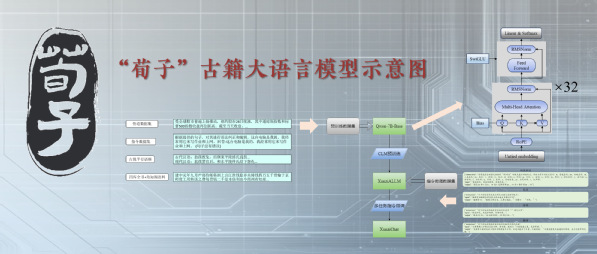
A college research team from East China’s Jiangsu Province has recently released China’s first large language model (LLM), a type of artificial intelligence (AI) algorithm that uses deep learning techniques and massively big data sets to help conduct research on Chinese ancient books.
The LLM for ancient books was designed to intelligently process ancient texts, promote innovative development in the research and preservation of Chinese ancient books, enhance the efficiency and quality of the inheritance of traditional Chinese culture, and facilitate deep integration between LLMs and the processing of ancient books.
The LLM “Xunzi,” named after Xun Zi, one of the most famous philosophers in ancient China for his Confucian classic Xunzi, contains the vast majority of Chinese ancient books and documents including the collections of the “Complete Library in Four Sections” or “Siku Quanshu,” with a large-scale corpus of over 2 billion Chinese characters and words.
The research on Chinese traditional classics is a painstaking and laborious work even for scholars and experts, let alone for average learners. Thus, translating ancient texts into modern Chinese is one of its most important functions, Wang Dongbo, professor from College of Information Management of Nanjing Agricultural University in Nanjing, Jiangsu, who led the research team told the Global Times.
With the model, researchers can swiftly summarize the ancient texts and know about the themes of the ancient books. The model can also extract key information from the ancient texts, such as characters, events and places, to sort out the information with efficiency.
Besides, the model can also automatically generate ancient poems that comply with grammar and prosody rules with the prompts the users give to it to provide inspiration for poetry lovers. It can also precisely translate ancient texts into modern Chinese to help researchers understand the original meaning and connotation of ancient texts.
Led by Wang, the research team has been working in the area of digitization of ancient books and documents for a decade. Supported by the presence of the university’s strong computing power and based on the application scenarios provided by Zhonghua Book Company, the research team accomplished China’s first open-source LLM for ancient texts in AI.
The LLM has been published on websites such as github.com and modelscope.cn as open-source software, allowing users to download and use it for free.
“We trained Xunzi using big data built on ancient books which can be obtained for free on the internet just like the way OpenAI trained ChatGPT. Although we spent great effort, labor force and money into it, we still share it for free with the aim to encourage more people to study and pay attention to traditional Chinese culture,” Wang said.
What does it feel like to dive 100 meters deep under the surface of the ocean with one breath? "The hydrostatic pressure will be 11 times than that a person feels on the ground," Xu Tongtong, Chinese freediver and the country's record breaker, told the Global Times in a recent interview.
A person now titled with two record-breaking champions, the 35-year-old Xu is now the first woman of China reaching 100 meters under the sea level in history, after she claimed a gold in Constant weight (CWT) freediving discipline in Asian Freediving Cup in the Philippines in June.
The win of her first 100-meter try gave her courage.
During July, in another competition she participated in AIDA Panglao Depth Championship in Bohol Island, the Philippines, Xu finished her another 100-meter challenge in the Constant weight bi-fins (CWTB) depth discipline, ranking second place in the world.
"If we compare the 100 meters to the height of a building, it means we are about to jump from the 30th floor to the ground and then climb back to the roof top, with one breath," Xu added. "I feel so happy when I touched and grabbed the tab underwater.
This was a goal I set for myself three years ago, and I feel nice that the world can see the efforts we made as Chinese freediving athletes," she told the Global Times in an interview on the phone at her home in the Philippines.
The two records Xu set pushed China to reach the next level: Since then the depth record of Chinese women in freediving has entered the 100-meter level.
'First try'
Xu now lives in Boho Island, an area covering an area of 3,269 kilometers and known as top island in the Philippines.
The Boho Island has been boasting its hospitality of the freediving lovers. And it is also among the most popular freediving destinations in the country where international competitions are often held here.
But for Xu, the place means much more than a freediving heaven, as both of the two competitions she participated in with record breaking also took place here in Boho Island.
June's competition is her first ever try in challenging 100 meters freediving. "I made it," recalled Xu. "That was an unprecedented experience for me as I remembered my smile as I swam up out of the surface."
Before heading to the competition, she undergone a three-month systematic training where her coach developed a training program cut out for her.
"There were different proportions I needed to devote to in including the physical training and muscle training."
Based on her training plan, the last training Xu had the free diving reached 98 meters under the water. "By two meters deeper during each try, I would reach 100 meters by the time of my competition day."
"This needs a stable state of mind. If you're nervous you fail, but if you're not you win," Xu added.
Explaining the trick of the sport, Xu said that it is the opposite of the others as one needs to calm her/him down to be "as stable as possible in order to slow down the heart rate, which is essential to reduce the oxygen consumption."
A yearn for ocean
Born in Anhui, a landlocked province in East China, the 35-year-old free diver has a nickname Mutou, translated as wood often known by her friends. She also named her social media atlas after Mutou.
She believed in the flexibility of the wood as "a piece of wood can be carved into anything you want. And I wish I can have the quality just as the wood."
Xu started her swimming training as early as 8. Being a professional swimmer, Xu has participated in a string of competitions nationwide, where she won second place as her best result.
Xu's free diving enlightenment came from a video she accidentally came across on social media. As early as 2012, when she saw the famous French freediving champion Guillaume Néry "flying" in the ocean.
"Normally we swim horizontally, but I never try swimming vertically. And I decided to have a try."
From 2012 to 2017, Xu has traveled to islands across the world for freediving, where she would immerse in the enjoyment the ocean brought her.
"If we carry gas cylinders, the bubbles that pop out will keep those sea creatures from approaching us. We are just 'guests' in the ocean, and in the ocean, we are so small," said Xu.
In the years of her career in ocean, she also received help from Israeli freediving legend Aharon Solomons, who she met in China when the later traveled there for freediving classes.
According to Solomons, freediving is a kind of sport that requires intelligence, commitments and common sense, where he believed that Xu has all of them.
Among many sports, freediving can be dangerous, but "she has been outstanding," Solomons told the Global Times in an interview.
"I also feel honored that he coached me during my entering stage of the sport, and I've never experienced from a single injury," Xu recalled her experience when learning from Solomons.
Now in Israel, Solomons is still preparing for more competitions as he told the Global Times.
Archaeologists will perform desalination on the Nanhai (South China Sea) No.1, the shipwreck of a cargo ship from the Song Dynasty (960-1279), and remove caissons for permanent protection, an expert from the Maritime Silk Road Museum of Guangdong in Yangjiang, South China's Guangdong Province, told the Global Times on Sunday.
Starting in 2013, excavation work on the shipwreck was officially finished in November, 2023. The upcoming work marks the beginning of a new phase as the focus of efforts shifts from excavation to overall preservation, research, interpretation, use, exhibition, and academic exchanges, according to a press release the museum sent to the Global Times on Friday.
Chinese archaeological teams have transferred the ship's hull to the museum, the press release said.
After the completion of a long-term support structure for the Nanhai No.1, the plan for the upcoming years involves the removal of a submerged box that has accompanied the ship's hull for many years. This will allow the public to have a closer look at the true appearance of the ship's body, read the release.
Ye Daoyang, deputy director of the museum's Underwater Archaeology and Technology Department, told the Global Times that the National Cultural Heritage Administration initiated the comprehensive protection and excavation project for Nanhai No.1 in November 2013.
From 2013 to 2023, Chinese archaeologists have focused on the comprehensive excavation phase after salvaging the entire ship, which involved cleaning the silt and artifacts inside the ship's body, leaving only the ship's structure. The next steps will include mapping the ship's body and performing desalination protection.
According to Ye, protecting and preserving a sunken wooden ship from the sea is a global-level challenge, and the Nanhai No.1, an 800-year-old shipwreck, is entering a critical phase in the long-term protection, research, and restoration of the ship's body and underwater artifacts. Various tasks, including the effective removal of sulfur-iron compounds and soluble salts, and dehydration and shaping, will be undertaken in the coming years to ensure the long-term and safe preservation of the Nanhai No.1 and its underwater artifacts.
In August 2023, archaeologists successfully completed the extraction of artifacts from the ship's hold. Exceeding 180,000 items, the recovered artifacts include various kinds of ceramics, gold, silver, copper, human remains, marine life, and terrestrial plants and animals, as well as glass and other material specimens. The ceramics include products from most of the ceramic kiln sites of the ship's era. The total weight of iron concretions exceeded 130 tons, CCTV reported.
Archaeologists once commented that the Nanhai No.1 archaeological project has set a benchmark for underwater archaeology in China, while providing a Chinese solution for the comprehensive protection of sunken cultural heritage worldwide. This excavation has enriched the historical records of the Maritime Silk Road, offering a clear glimpse into international maritime trade 800 years ago and showcasing the history of this important trade route to the world in the 21st century, according to CCTV.