China's PPI up 0.5% in March, marking growth for first time in over 3 years
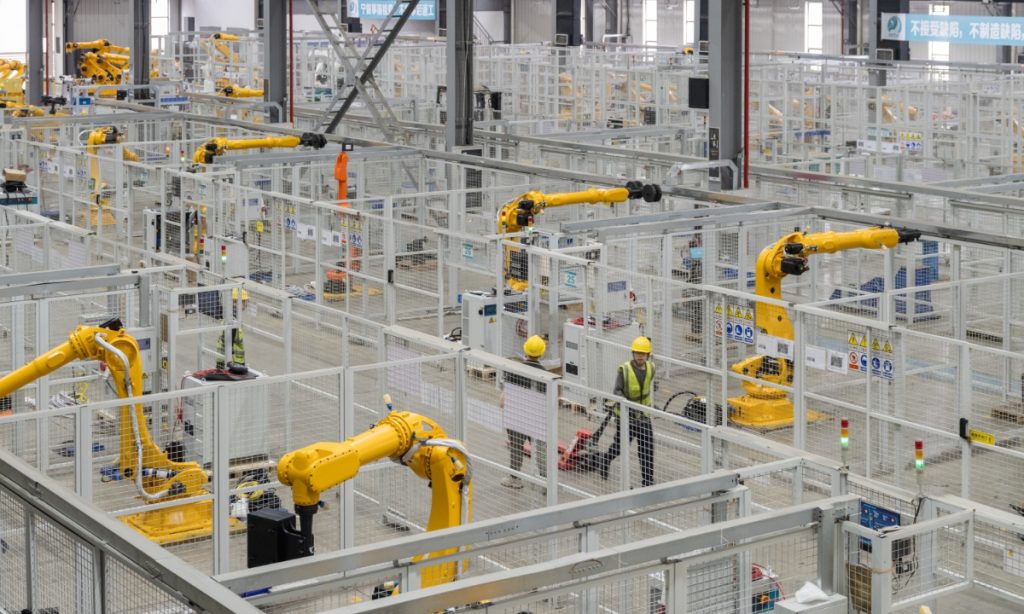
China's Producer Price Index (PPI), which measures prices at the factory gate, rose 0.5 percent year-on-year in March, reversing a 0.9 percent decline in the previous month and marking the first increase in more than three years, data from the National Bureau of Statistics (NBS) showed on Friday.
NBS statistician Dong Lijuan attributed the turnaround mainly to imported inflationary pressures and improved supply-demand dynamics in some domestic industries.
Prices in the mining and processing of non-ferrous metal ores rose 36.4 percent year-on-year in March, up 6.2 percentage points from the previous month, while prices in the smelting and processing of non-ferrous metals rose 22.4 percent, up 0.3 percentage points from the previous month.
Prices in petroleum and natural gas extraction shifted from a 12.9 percent decline in the previous month to a 5.2 percent increase in March. Meanwhile, prices in the processing of petroleum, coal, and other fuels, and in the manufacture of raw chemical materials and chemical products fell by 4.5 percent and 0.3 percent, respectively, in March, with the rates of decline narrowing by 7.5 and 3.4 percentage points from the previous month, NBS data showed.
Meanwhile, improved supply and demand conditions in some domestic industries led to higher prices, according to Dong.
"Market competition has become more orderly, with prices for photovoltaic equipment and components and lithium-ion batteries rising by 5.2 percent and 2.5 percent, respectively," Dong said.
New growth drivers also gained momentum. With the accelerated expansion of "AI+" and rapid growth in demand for computing power, prices in optical fiber manufacturing rose 76.1 percent, prices for external storage devices and components rose 21.1 percent, and prices in the manufacture of electronic specialty materials rose 18.7 percent, according to the NBS.
Additionally, the green transition supported growth, with prices in biomass fuel processing and the comprehensive utilization of waste resources rising by 6.1 percent and 0.9 percent, respectively.
"While soaring international bulk commodity prices partially pushed up the PPI, the positive change also reflects the gradual recovery of the domestic industrial market and proves the effectiveness of policies including building a unified national market and anti-involution campaign," Li Changan, a professor at the Academy of China Open Economy Studies at the University of International Business and Economics, told the Global Times on Friday.
Friday's data also showed that China's consumer price index (CPI), a main gauge of inflation, rose 1 percent year-on-year in March. The core CPI, which excludes food and energy prices, increased 1.1 percent year-on-year, according to the NBS.
"The CPI growth rate indicates that the country maintains a moderate level of inflation, and is steadily advancing toward the annual CPI growth target of around 2 percent set out in this year's Government Work Report," Yang Delong, chief economist at Shenzhen-based First Seafront Fund, told the Global Times on Friday.
"The moderate rise in prices reflects the gradual recovery of domestic demand, which is highly conducive to stabilizing economic growth and boosting consumer confidence. To stabilize economic expansion, the Chinese government is implementing more proactive and effective macro policies, driving simultaneous recoveries in both CPI and PPI by stimulating investment, boosting consumption and spurring aggregate demand," Yang said.
According to the National Development and Reform Commission (NDRC), the country's top economic planner, the NDRC and the Ministry of Finance have recently allocated the second batch of 62.5 billion yuan ($9.15 billion) in ultra-long special treasury bond funds to support the trade-ins of consumer goods for 2026.